Wind Shear Masterclass
Key strategies for detecting, avoiding, and recovering from wind shear

Replacing this week’s tech quiz is a major A320 Knowledge deep dive.
Wind shear is one of the most hazardous phenomena we can face. It’s often invisible to the naked eye, and in its most dangerous form — microbursts — can turn a routine flight into a crisis in mere seconds. Understanding and effectively responding to wind shear is vital for ensuring the safety of passengers, crew, and aircraft.
In this article, we’ll explore deep into the dynamics of wind shear, its impact on aviation safety, and the techniques us Airbus pilots use to detect, avoid and recover from them.
Let’s dive right in.
Insights at a Glance:
Wind Shear Overview: Learn how sudden changes in wind direction and speed during key phases like takeoff and landing can impact aircraft performance.
Microburst Hazards: Understand the dangers posed by microbursts, which feature rapid downdrafts and severe wind shifts, complicating recovery efforts.
Detection Tools and Systems: Explore the essential tools for identifying wind shear, including weather radar, onboard systems, and air traffic control reports.
Best Practices for Pilots: Discover key strategies pilots can use to minimize risk during takeoff and landing, like adjusting speeds and maintaining appropriate thrust.
Wind Shear Recovery Techniques: Gain insight into the recovery procedures pilots should follow, including the use of TOGA thrust and pitch adjustments, to regain control during wind shear encounters.
Subscribe to the A320 Knowledge YouTube Channel!
What is Wind Shear?
Wind shear refers to any sudden and drastic change in wind velocity and/or direction over a short distance. These rapid changes can occur at various levels of the atmosphere, and the effects on aircraft can be severe. For simplicity, wind shear is often divided into two categories: vertical and horizontal.
Vertical Wind Shear
Vertical wind shear occurs when there is a change in wind velocity along the vertical axis. Typically, vertical wind shear is measured in knots per 1,000 feet, with a variation of 20 to 30 knots. This type of shear can significantly affect aircraft lift, airspeed, and thrust requirements when the aircraft climbs or descends through different wind layers. It’s a common phenomenon near thunderstorms, mountain waves, or temperature inversion layers.
Horizontal Wind Shear
Horizontal wind shear happens when there’s a change in wind components along the horizontal axis—such as shifting from a headwind to a tailwind or vice versa. The variation can be as much as 100 knots per nautical mile. These shifts in wind direction can cause dramatic changes to the aircraft’s lift and airspeed, leading to unexpected flight dynamics.
Wind shear is most dangerous when it occurs at low altitudes, where the aircraft is at its most vulnerable. Rapid changes in wind can lead to sudden losses of airspeed and altitude, posing significant risks during critical phases of flight such as take-off, approach, and landing.
Identifying Wind Shear
Although experiencing severe wind shear is rare, early recognition is crucial for the effective implementation of recovery procedures. By understanding how to detect wind shear, pilots can take timely action to ensure a safe response.
Several indicators can signal a wind shear encounter and should prompt the flight crew to remain vigilant. These include:
A sudden change in indicated airspeed exceeding 15 knots
Significant variations in ground speed
Shifts in wind direction or speed on the analog wind indicator
Vertical speed changes of 500 feet per minute
Pitch attitude fluctuations greater than 5 degrees
Glide slope deviations of 1 dot
Heading changes of 10 degrees or more
Unusual behavior from autothrust or auto throttle systems
Onboard Wind Shear Warning Systems
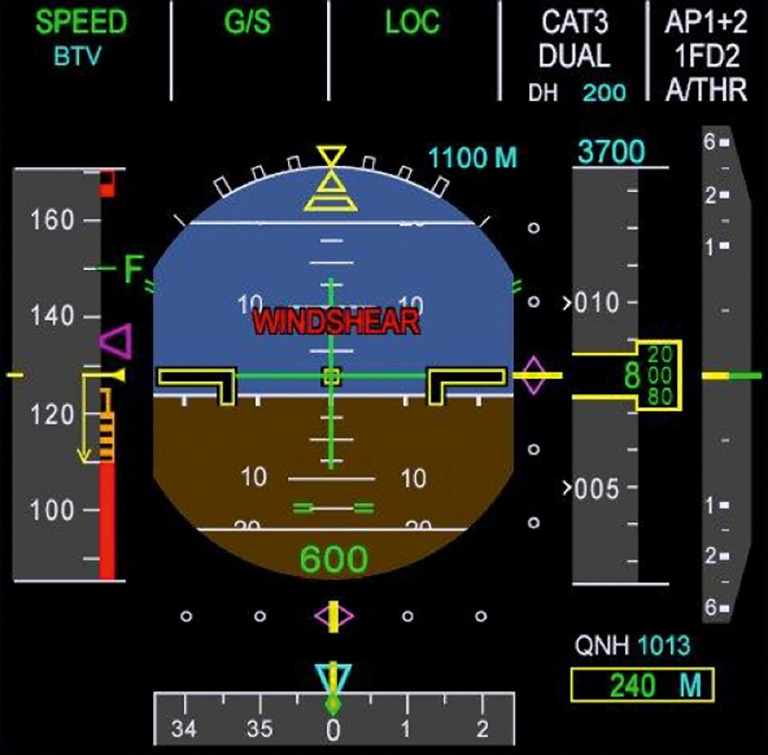
Modern aircraft are typically equipped with reactive wind shear detection systems. These systems monitor both vertical and horizontal wind velocities to identify sudden wind changes. Upon activation, the system audibly announces “WIND SHEAR” three times, accompanied by a red "WINDSHEAR" warning on the Primary Flight Display (PFD) - see picture below.
The combination of the wind shear detection system and the Speed Reference System (SRS) creates the Reactive Wind Shear System (RWS). This system offers an immediate response to wind shear conditions by adjusting aircraft parameters in real time.
Microbursts: The Hidden Danger
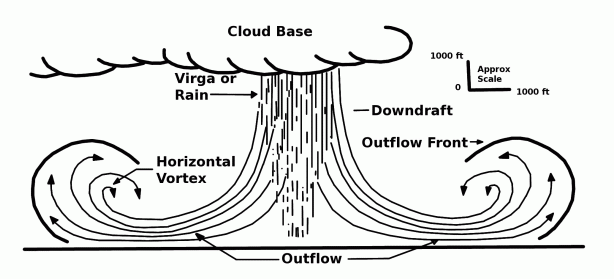
Among the various forms of wind shear, microbursts are the most dangerous. A microburst is a small but exceptionally powerful downdraft of air that rapidly descends to the ground and spreads outward in all directions, creating a ring vortex. Microbursts typically form near thunderstorms and cumulonimbus clouds, and they can cause sudden, severe wind changes near the surface. These effects can significantly disrupt the aircraft's ability to maintain flight stability.